
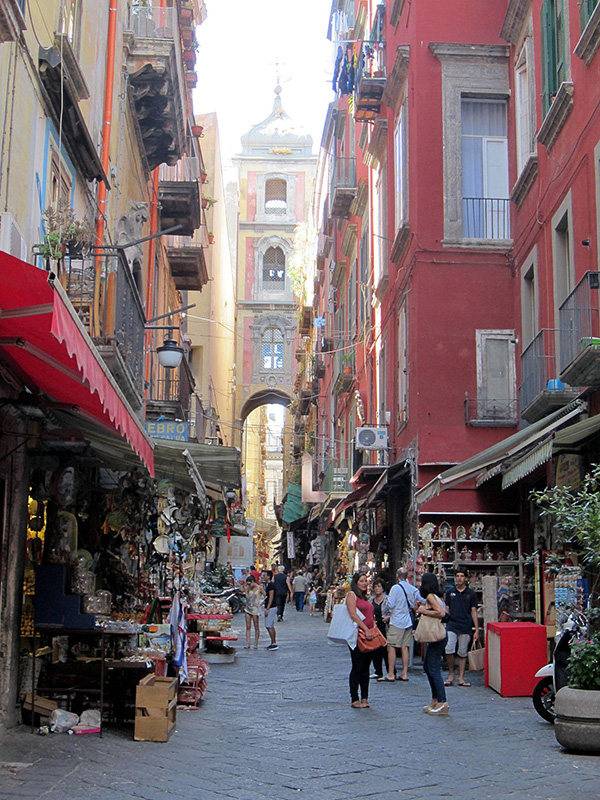
Via San Gregorio Armeno, Naples
Via San Gregorio Armeno is one of the oldest and most storied streets in the historic centre of Naples, running between two of the city’s ancient main arteries — Via dei Tribunali to the north and Spaccanapoli (Via San Biagio dei Librai) to the south. The street follows the layout of the ancient Greek city of Neapolis, serving as a stenopos — a narrow cross-street linking the two great plateiai or decumani. Its origins predate Christianity: in Roman times, a temple dedicated to the goddess Ceres stood here, and worshippers would bring small handmade terracotta figurines as offerings — a practice that, through a remarkable continuity of craft, is echoed by the artisan workshops that line the street to this day.
The street takes its name — and its Armenian connection — from the 8th century, when a group of nuns fleeing iconoclast persecution in the Byzantine Empire arrived in Naples carrying the relics of Saint Gregory the Illuminator (Grigor Lusavorich), the founding patriarch of the Armenian Apostolic Church. The nuns settled here, established a religious community, and their presence gave the street its enduring name. This makes Via San Gregorio Armeno one of the rare public spaces in Western Europe whose very name preserves the memory of an Armenian religious community going back over twelve centuries.
The street is also home to the bell tower of the Church of San Gregorio Armeno, which spans the road on an arch — one of the most distinctive visual features of the via. The tower serves as a bridge connecting the church on one side with the monastery on the other. This overpass, which has stood since Norman times, gives the street its characteristic silhouette and makes it instantly recognisable.
Today Via San Gregorio Armeno is internationally known as the “Street of the Nativity Scenes” (Via dei Presepi), lined year-round with workshops producing the handcrafted terracotta figurines that are a hallmark of Neapolitan culture. The art of the Neapolitan nativity scene was inscribed on the UNESCO list of Intangible Cultural Heritage of Humanity in 2017. For visitors tracing Armenian heritage in southern Italy, the street is a living testament to the profound and lasting mark left by an Armenian community that arrived in Naples over a thousand years ago.
Photo credit: visitnaples.eu
Group: Historic Street
Type: Street
Century: 8th century, 9th century, 10th century, 11th century, 12th century, 13th century, 14th century, 15th century, 16th century, 17th century, 18th century, 19th century, 20th century, 21st century
Geography: Italy, Campania, Naples
Latitude: 40.850104081525, Longitude: 14.257810993841
Alternative names: Via dei Presepi, Christmas Alley, San Liguoro street
Contributed by: Armenian Heritage