
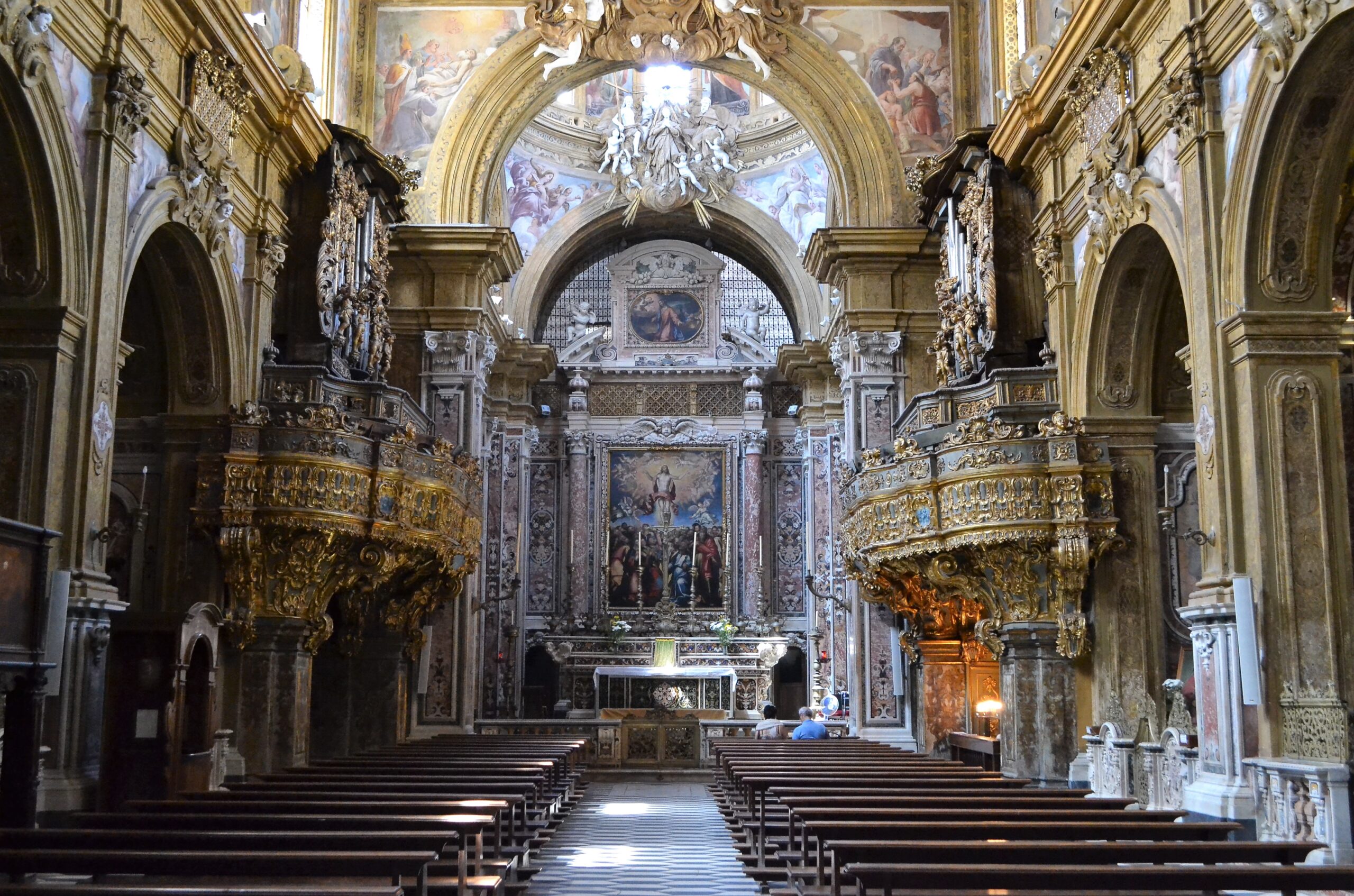
Church of San Gregorio Armeno, Naples
The Church of San Gregorio Armeno is one of the most important Baroque complexes in Naples and one of the most remarkable monuments of Armenian heritage in all of Western Europe. Its origins lie in the 8th century, when a group of Byzantine nuns fleeing the iconoclast persecutions of Emperor Leo III arrived in Naples bearing the relics of Saint Gregory the Illuminator (Grigor Lusavorich), the founding patriarch of the Armenian Apostolic Church and the apostle of Christianity in Armenia. The nuns settled on the site of an ancient Roman temple dedicated to the goddess Ceres, established a monastic community, and built the earliest church on the site. The community took the name of their saint, making this one of the oldest Armenian dedications in Italy.
The church as it stands today is largely a product of the 16th century. Construction of the new building began in 1574 to designs by architect Giovanni Battista Cavagni, and the church was consecrated in 1579. The interior is a single-nave structure of extraordinary richness, featuring a celebrated gilded coffered wooden ceiling commissioned by abbess Beatrice Carafa and painted by the Flemish master Teodoro d’Errico (Dirk Hendricksz), depicting scenes from the life of Saint Gregory. The cupola was decorated in 1679 by the Neapolitan painter Luca Giordano with a Glory of San Gregorio, and in 1684 Giordano painted the counter-façade with three fresco scenes narrating the founding story of the monastery: the Armenian nuns’ voyage to Naples, the translation of Saint Gregory’s relics, and the nuns’ reception by the Neapolitans. The church also preserves a medieval Byzantine icon of the Madonna dell’Idria in the Idria Chapel, surrounded by eighteen paintings by Paolo De Matteis.
The monastery cloister, designed in 1580, is considered one of the finest in Naples. At its centre stands a Baroque marble fountain decorated with dolphins, masks and seahorses, surmounted by statues of Christ and the Samaritan Woman by Matteo Bottiglieri (1733). The church also holds the relics of Saint Patricia (Santa Patrizia), a Byzantine noblewoman and descendant of Emperor Constantine who died in Naples; her powdered blood is said to liquefy every Tuesday, a phenomenon that draws devout visitors throughout the year. The church’s bell tower spans the street below on an arch, serving as a bridge between the church and the monastery — one of the most distinctive features of the via.
The church is dedicated to Saint Gregory the Illuminator (Surp Grigor Lusavorich, c. 257–331 AD), the patron and first Catholicos of the Armenian Apostolic Church, and his head relic is kept here. It stands as a unique monument to the deep roots of Armenian Christianity in the Mediterranean world, and to the journey of a small community of Armenian nuns whose arrival in Naples over twelve hundred years ago shaped the identity of an entire neighbourhood.
Photo credit: Giuseppe Guida
Group: Religious Building
Type: Church
Century: 8th century, 16th century, 17th century
Geography: Italy, Campania, Naples
Latitude: 40.849795159289, Longitude: 14.257869514111
Alternative names: San Liguoro Church, Santa Patrizia Church, Chiesa di San Gregorio Armeno
Contributed by: Armenian Heritage