
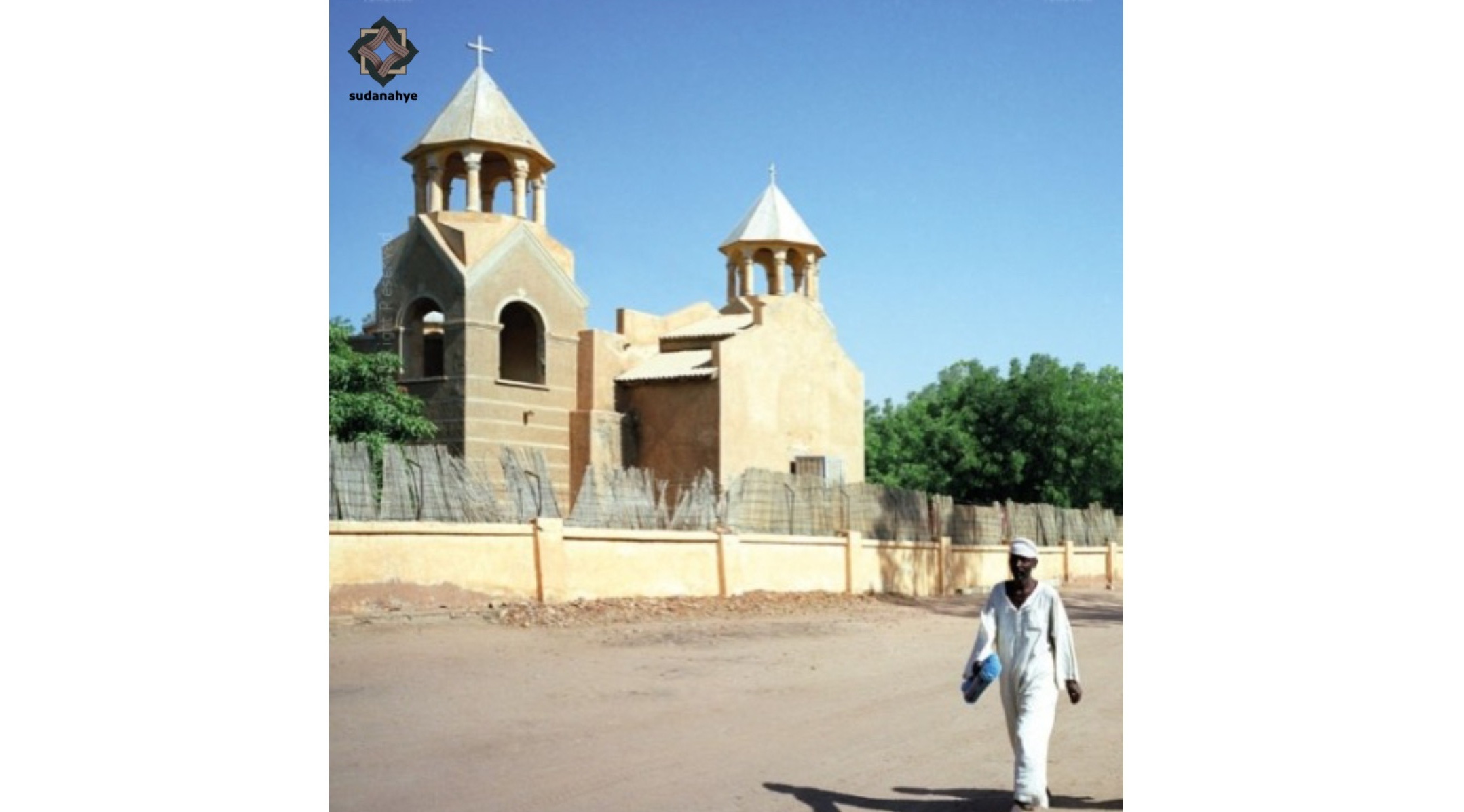
Church of Saint Gregory the Illuminator, Khartoum
The Church of Saint Gregory the Illuminator (Surp Krikor Lusavorich) in Khartoum was the spiritual centre of the Sudanese-Armenian community — a community that, at its peak, was prosperous, well-integrated, and deeply embedded in the social and economic life of Sudan, yet which has now almost entirely ceased to exist.
Armenians first arrived in Sudan in significant numbers in the early 20th century, many as survivors of the 1915 Armenian Genocide, moving along existing trade routes that connected Egypt and the wider Middle East with the Nile Valley. Three distinct waves of immigration shaped the community: the first in the early 20th century, including those displaced after the Adana massacres; the second as genocide survivors sought refuge as far south as possible from the Ottoman heartland; and later arrivals who continued to build on these networks. They settled primarily in Khartoum, with smaller communities in Kassala and Gedaref, where an Armenian school also operated. By the time Sudan gained independence in 1956, Armenians were a well-established and respected minority, with community life centred on three institutions: the church, the club, and the school.
The church was built with major funding from the Kurkjian family, who founded one of Sudan’s most successful companies — supplying the government with food, and building roads, bridges, and railway lines. The Kurkjian family were emblematic of the broader Armenian presence in Sudan: entrepreneurial, multilingual, and commercially indispensable. Other Armenians ran department stores, studios, and factories; Zarouhi Sarkissian was one of Sudan’s first two female doctors, graduating in 1952. As Father Gabriel Sargsyan is remembered to have said, “As long as there is one Armenian left, there will be a church.”
The community began to decline after the nationalisation policies of the 1970s, which forced many Armenians to leave. Those who remained continued to gather at Saint Gregory’s until the war that erupted in Sudan in 2023 appears to have driven out the last members of the community. Two Armenians — the sisters Zvart and Arpi Yegavian — died in their home in Khartoum at the outbreak of the conflict. The church, like much of Khartoum, now bears the scars of war. Whether it can be preserved remains uncertain.
The history of the Sudanese-Armenian community is currently being documented by the multimedia project sudanahye.com, founded by Vahe Boghosian with support from the Calouste Gulbenkian Foundation.
Photo credit: Sudanahye picture archive
Group: Religious Building
Type: Church
Century: 20th century
Geography: Sudan, Khartoum
Latitude: 15.590772962235, Longitude: 32.54100361835
Alternative names: Surp Krikor Lusavorich Church Khartoum, Armenian Apostolic Orthodox Church
Contributed by: Armenian Heritage