
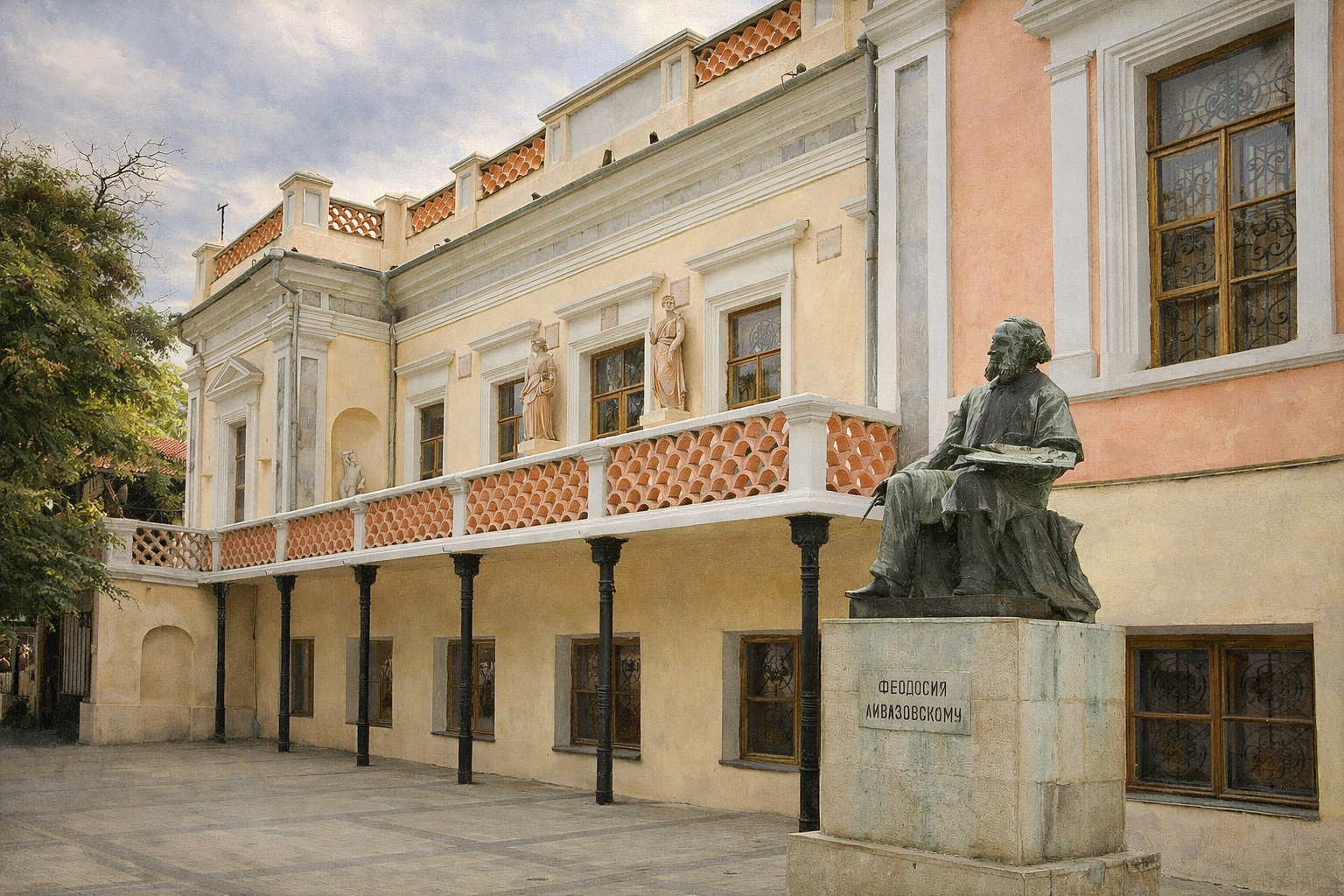
Ayvazovski National Art Gallery
The Aivazovsky National Art Gallery’s history dates back to 1845, when Ivan Aivazovsky acquired a plot of land on the outskirts of Feodosia, right on the seashore. He built a house with a large art studio and planned to establish a school of painting there. In the same year, the first exhibition was opened in his house, featuring 49 of his works.
In his Feodosia studio, Aivazovsky created numerous paintings, including seascapes of Italy, Constantinople, Odessa, and Sevastopol, as well as many works dedicated to Crimea, the Black Sea, the Crimean War of 1853–1856, and the Siege of Sevastopol of 1854–1855.
In 1865, he opened an art studio in the city at his own expense. Among his students were Lev Lagorio, Adolf Fessler, Konstantin Bogaevsky, Maximilian Voloshin, Konstantin Artseulov, Mikhail Latri, and a group of Armenian artists. Teaching followed the academic method: students copied original paintings and drew from life, and the best works were sent to the Academy for encouragement.
As the number of students grew, Aivazovsky decided to add an exhibition hall to his house. The official opening of the gallery took place on July 29, 1880, timed to the artist’s birthday. It became the first provincial art gallery in Russia and was already very popular during his lifetime. The collection was continuously updated, as paintings were sent to exhibitions and not returned, being replaced by newly created works.
The gallery became the third museum in the Russian Empire, after the Hermitage Museum and the Tretyakov Gallery. After Aivazovsky’s death in 1900, ownership of the gallery was transferred to the city according to his testament.
Towards the end of 1920, the house was occupied by the Feodosia department of the Cheka, and several paintings were damaged.
Since 1922, the gallery has functioned as a state museum in the USSR. Today, the collection includes about 12,000 works with a nautical theme, including the world’s largest collection of Aivazovsky’s works (417 paintings). The exhibition presents his works, his family history, and the history of the gallery. A separate building (the artist’s sister’s house) displays mythological and biblical paintings, foreign marine art of the 18th–19th centuries, and works of the Cimmerian school, including Isaac Levitan, Maximilian Voloshin, Lev Lagorio, Konstantin Bogaevsky, Mikhail Latri, Adolf Fessler, and Arkhip Kuindzhi.
In 1930, a monument to Aivazovsky by Ilya Ginzburg was erected in front of the main building, bearing the inscription: “Feodosia to Aivazovsky.”
Group: Civil Structure
Type: Museum, Exhibition Area
Century: 19th century
Geography: Feodosia, Crimea
Latitude: 45.032248497974, Longitude: 35.382797200044
Alternative names:
Contributed by: Armenian Heritage