
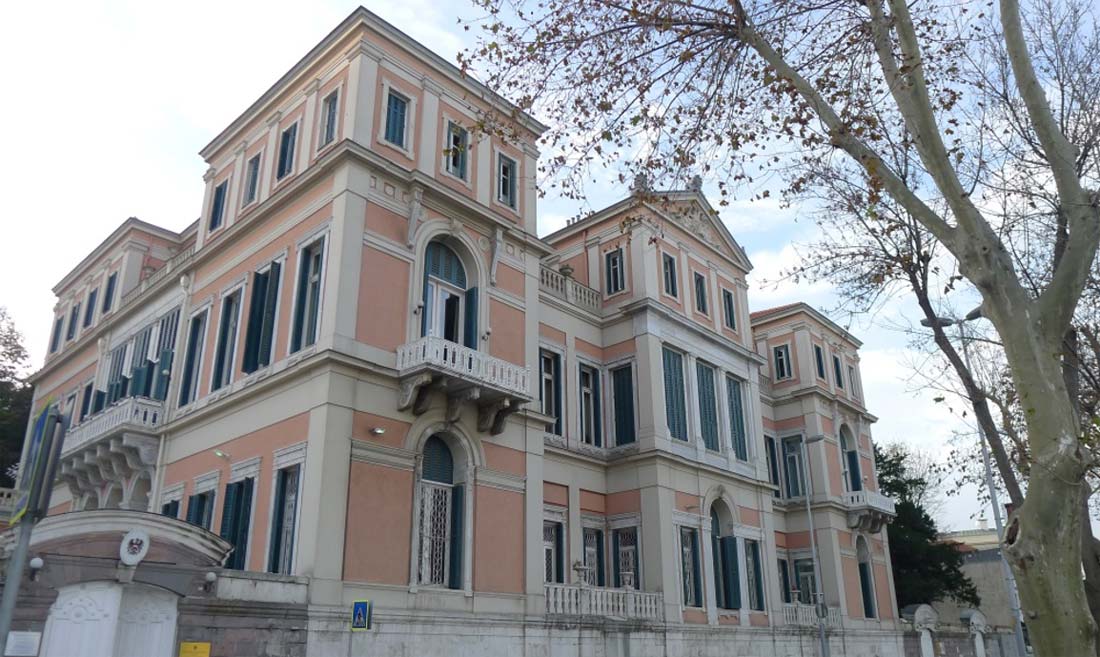
Austrian Consulate General
The Austrian Consulate General in Yeniköy, on the European shore of the Bosphorus, owes its existence to two Armenian figures whose contributions are rarely mentioned in the same breath.
The building was originally commissioned by Mıgırdıç Cezayirliyan (1805–1861), a prominent Armenian banker and entrepreneur who was one of the most influential figures in Ottoman economics between the 1840s and 1850s. Among his achievements was the construction of the first bridge over the Golden Horn in 1836. The neoclassical palace was designed by another Armenian – architect Mıgırdıç Kalfa Çarkyan – but construction was halted after Cezayirliyan’s property was confiscated by Ottoman tax authorities due to unpaid debts. The building was never completed under his ownership.
In 1882, the compound was gifted by Sultan Abdülhamid II to Emperor Franz Josef I – at the time reportedly in a semi-ruinous condition, with the roof and second floor largely missing and the central hall open to the skies. Between 1894 and 1898 Austria fully rebuilt and restored the palace, giving it the imperial interior it has today.
After World War I it remained the only Austro-Hungarian diplomatic property to pass to the Austrian Republic. It then briefly became German property following Austria’s annexation in 1938, before being returned to Austria in 1947.
Today the building serves as the Austrian Consulate General and Cultural Forum – one of the most striking examples of 19th-century diplomatic architecture on the Bosphorus, and a little-known chapter in the story of Armenian influence on Istanbul’s built heritage.
Photo credit: bosphorustour.com
Group: Administrative Building
Type: Embassy, Mansion, Villa, Residence
Century: 19th century
Geography: Istanbul, Marmara Region, Sarıyer, Turkey, Yeniköy (Sarıyer)
Latitude: 41.1261063, Longitude: 29.0702801
Alternative names: Cezayirliyan Mansion, Austrian Embassy Summer Residence
Contributed by: Culture Inventory, Armenian Heritage