
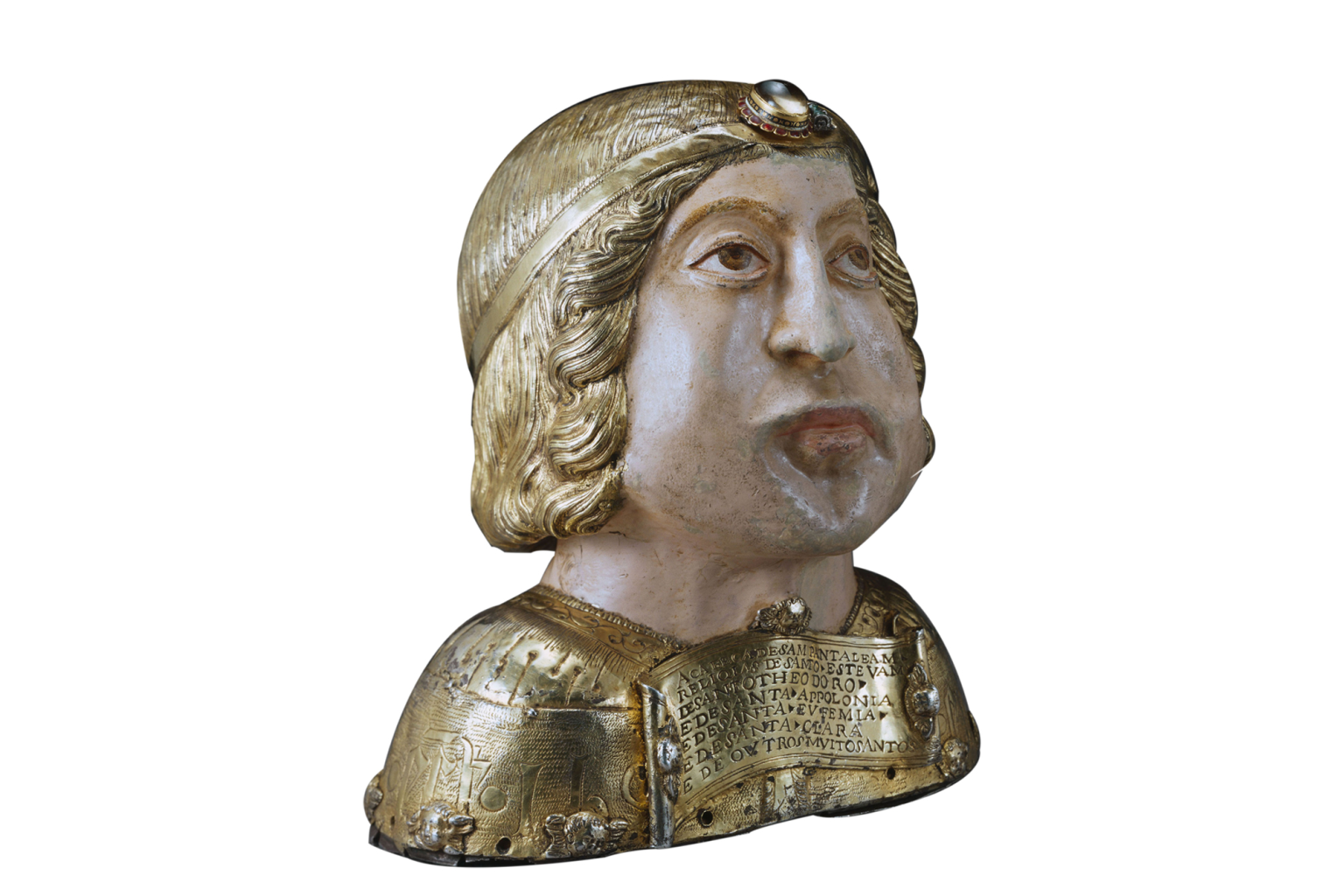
Relics of St Pantaleon, Porto
The cult of St Pantaleon has a long tradition in the Catholic Church. The 3rd and 4th century martyr was the patron saint of the city of Porto for several centuries until, in 1984, the city’s patron saint was changed to Our Lady of Vandoma.
Devotion to St Pantaleon, a doctor martyred in the ancient Greek city of Nicomedia in 303 AD, began in Porto through the influence of a group of Armenian Christians. According to reports from the time, this group is said to have arrived in Porto at the end of the Middle Ages, bringing with them the relics of the saint, which they deposited in the Church of São Pedro de Miragaia.
In 1499, by decision of Bishop D. Diogo de Sousa, the relics were transferred to Sé Catedral do Porto. A fragment of Saint Pantaleon’s skull was kept in the reliquary bust, which was used when visiting the sick.
This devotional object, which has been part of the Soares dos Reis National Museum collection since 1941, is one of the oldest reliquary busts known in Portugal. Due to the lack of similar objects, it is difficult to establish an exact chronology for its execution and to define the origin of its manufacture.
With no known authorship, crafted in white and gilded and painted silver, enamels, gold and smoky quartz, the reliquary bust of Saint Pantaleon dates back to the 15th and 16th centuries. It is classified as a National Treasure, due to its cultural value and significance for history and collective memory.
Group: Religious Object
Type: Bust
Century: 15th century, 16th century
Geography: Porto, Portugal
Latitude: 41.142897231409, Longitude: -8.610946383456541
Alternative names:
Contributed by: Armenian Heritage