
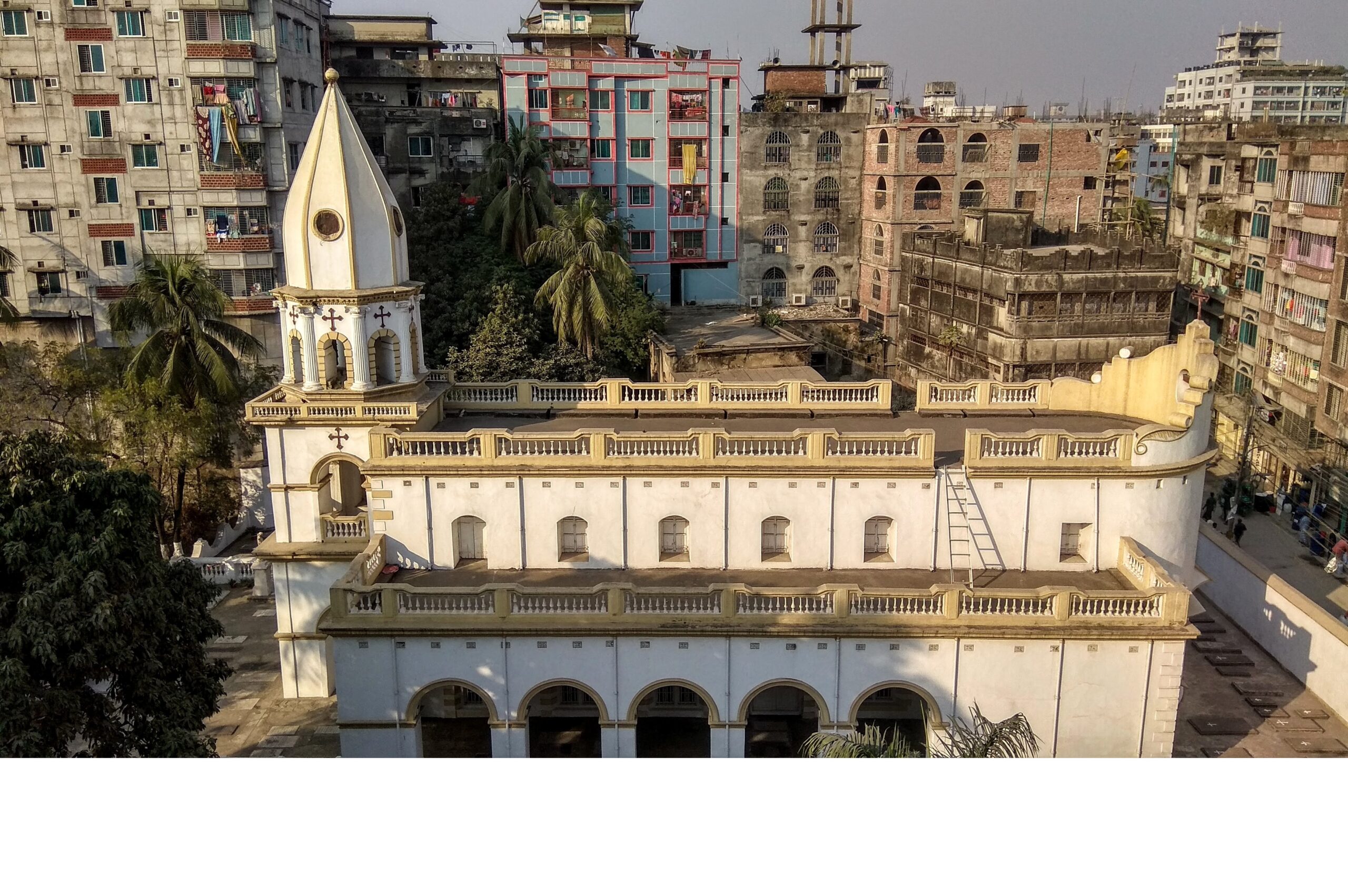
Armenian Church, Dhaka
The Armenian Apostolic Church of the Holy Resurrection in Old Dhaka is one of the most improbable and moving monuments of the Armenian diaspora: a beautifully preserved 18th-century church in the heart of Bangladesh, in a neighbourhood still called Armanitola — “the place of the Armenians” — long after the community that built it has almost entirely disappeared.
Armenian merchants arrived in Dhaka as early as the 17th century, drawn by the thriving textile trade of Bengal. Many Armenians moved eastward along Persian trade networks into the Mughal Empire; Persian was the official language of the Mughals, easing Armenian integration. They traded in jute, leather and silk, grew wealthy, and put down roots. The land for the church was donated by an Armenian named Agaminus Catchik, and the building was completed in 1781 on the site of an earlier Armenian graveyard, consecrated by Bishop Ephreim. The area around it had already taken the name Armanitola.
The church is a white-plastered two-storey structure of considerable architectural elegance, with four arched doors and 27 arched windows, a pulpit enclosed by railings, and a marble baptismal font three feet deep. Paintings decorate the interior. A clock tower was added within fifty years of construction; its bell could reportedly be heard four miles away and people synchronised their watches by it. The clock stopped in 1880 and the tower was destroyed by the earthquake of 1897. The old graveyard contains around 350 graves, some with Armenian inscriptions; one of the most striking is a statue of a woman placed on the grave of Catchik Avatik Thomas, inscribed with the words “Best of Husband.” It is said that Mother Teresa stayed in the church compound during a 1996 visit to Dhaka.
For much of the 20th century the church survived through the devotion of a single family. In the 1980s, when the building was at its most vulnerable and close to being seized, Mikel Housep Martirossian — known as Michael Joseph Martin — kept it alive through personal sacrifice and determination. He died in Canada in April 2020. The food assistance programme he established continues to this day: every Thursday, hundreds of Bangladeshi visitors come to the church, where babies receive milk and others are served full meals — the Michael Martin Food Assistance Program.
Today there are no known Armenian residents in Dhaka. The church is under the protection of Bangladesh’s Department of Archaeology and is open to visitors during the day. An Armenian resident priest has been in place since 2023.
Official web site of the: Armenian Church of Dhaka
Photo credit: Hasan Nahiyan Nobel
Group: Religious Building
Type: Church
Century: 18th century
Geography: Dhaka, Bangladesh
Latitude: 23.713139277068, Longitude: 90.402654625384
Alternative names: Armenian Church of Bangladesh
Contributed by: Armenian Heritage