
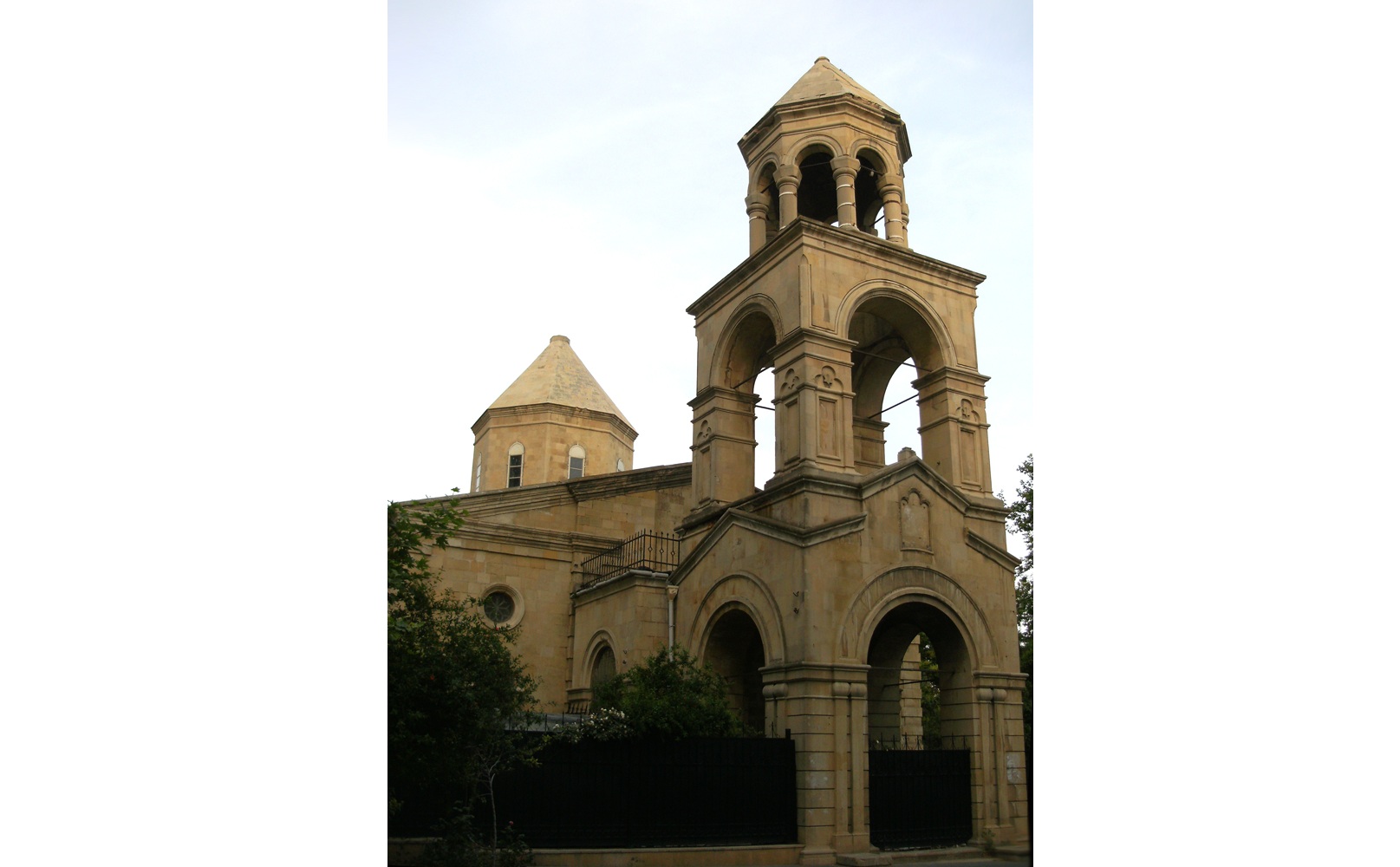
Surp Krikor Lusavorich Armenian Church, Baku
Saint Gregory the Illuminator Church, commonly referred to as the Armenian Church of Baku, is a former Armenian Apostolic church near Fountains Square in central Baku, Azerbaijan. Completed in 1869, it was one of the two Armenian churches in Baku to survive the Soviet anti-religious campaign, the Nagorno-Karabakh conflict, and the 1990 pogrom and exodus of Baku Armenians when it was looted. It is now the only standing Armenian monument in Baku.
The church was built between 1863 and 1869 by the design of Karl Hippius, a Baltic German architect. The construction was funded by Javad Melikiants (Melikov), a Baku-based Armenian philanthropist and founder of the city’s first paraffin plant. The church was consecrated on May 4, 1869, by archbishop Andreas Andreasian. The Armenian Philanthropic Society of Baku founded a girls’ school in 1866 and a library in 1870 next to the church.
Over the course of the 20th century, the Armenian church in Baku repeatedly became a target of violence and upheaval. In 1903, it was the site of a deadly clash between Russian Cossacks and Armenian activists defending church property; in 1918–1919, it was attacked, looted, and even fired upon by Ottoman and Ottoman-Azerbaijani forces. Although it survived the Soviet anti-religious campaigns and continued to function for decades, the situation deteriorated during the late 1980s amid the Nagorno-Karabakh conflict. Following pogroms and the mass exodus of Armenians from Baku, the church was set on fire in 1989 and left severely damaged, ultimately standing abandoned as a silent witness to the disappearance of the Armenian community from the city.
In 2002, the church was transferred to the Presidential Library, which is located nearby, and now houses its archive. In 2006 Azerbaijani Minister of Culture Abulfas Garayev stated that converting the church into a library is purposeful because there are not many Armenian Christians in Azerbaijan. Emil Sanamyan, fellow at the USC Institute of Armenian Studies, argued that it is a depository and not a library, as there is no public access. According to Samir Huseynov, it is open to PhD students and other researchers upon request.
In a 2021 interview, Azerbaijani president Ilham Aliyev claimed the church was repaired. “It is in the center of the city, and if anyone goes there, they will see that there are about 5,000 Armenian books there,” he told CNN Türk.
More here: Armenian Church, Baku.
Photo by Khortan.
Group: Religious Building
Type: Church
Century: 19th century
Geography: Azerbaijan, Baku
Latitude: 40.3717232, Longitude: 49.8363991
Alternative names:
Contributed by: Culture Inventory